
Short answer: There is not always one cause.
A short, sharp pain triggered by cold water, cold air, sweet foods or touch can be associated with dentin hypersensitivity, but not every cold-triggered toothache is “sensitivity”.
Caries, cracked teeth, pulpal problems, erosion, gum recession and some restorative problems can produce similar symptoms.
So the more useful question is not only:
“Why are my teeth sensitive to cold?”
but:
“When does the pain happen, how long does it last, and does its pattern need professional assessment?”

What is dentin hypersensitivity?
Dentin hypersensitivity is generally described as short, sharp pain arising from exposed dentin in response to stimuli such as:
- cold,
- heat,
- touch,
- air,
- sweet foods,
- chemical triggers,
when the pain cannot be explained by another dental condition.
This is important: cold pain alone does not establish a diagnosis of dentin hypersensitivity.
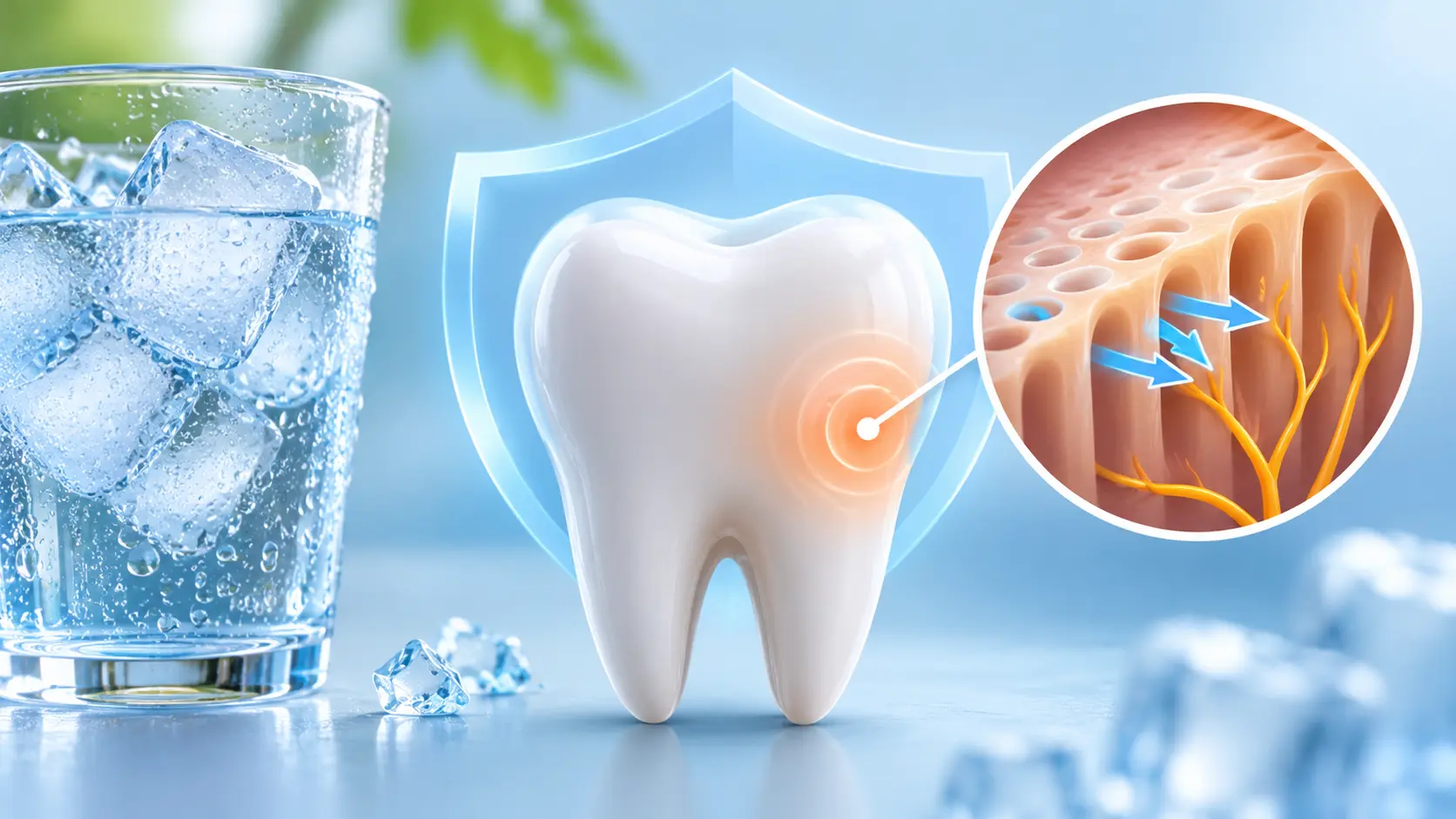
Why can cold trigger a sharp tooth pain?
Under enamel lies a tissue called dentin.
Dentin contains thousands of microscopic channels called dentinal tubules.
When dentin becomes exposed, some tubules may be open to the oral environment.
One of the most widely accepted explanations is the hydrodynamic theory.
According to this model, cold can cause movement of fluid inside open dentinal tubules. That movement may stimulate sensory nerves associated with the tooth and produce a short, sharp pain.
In simple terms:
Cold does not necessarily have to “touch the nerve” directly; fluid movement inside open dentinal tubules may trigger the pain signal.
Why can dentin become exposed?
Several factors may contribute.
Gum recession
When the gum margin recedes, root surfaces that were previously covered may become exposed.
Erosion
Repeated acid exposure can contribute to loss of hard tooth tissue over time.
Mechanical wear
Excessive brushing pressure or unsuitable technique may contribute in some people, especially when other factors such as recession or erosion are present.
This does not mean “brushing causes sensitivity”. Technique, pressure and individual conditions all matter.
Natural wear and age-related changes
Tooth surfaces can change over time.
After some dental procedures
Temporary sensitivity can occur after certain dental treatments or whitening procedures.
Does every tooth that hurts with cold have “sensitivity”?
No.
Cold-triggered pain can also occur with:
- tooth decay,
- cracked teeth,
- pulpal conditions,
- defective restorations,
- periodontal problems,
- fractures,
- other dental conditions.
So:
“Cold causes pain” is a symptom, not a diagnosis.

What kind of pain pattern deserves more attention?
Dentin hypersensitivity is usually described as:
- sharp,
- brief,
- triggered by a specific stimulus,
- reducing relatively quickly after the trigger is removed.
But pain should not simply be labelled “sensitivity” if it:
- lingers,
- starts spontaneously,
- wakes you at night,
- is severe,
- occurs with chewing,
- is focused in one tooth,
- comes with swelling,
- or becomes progressively worse.
Why can we start anticipating the pain before the cold drink even touches the tooth?
Repeated sensitivity can change behaviour.
People may:
- drink cold beverages more slowly,
- chew on one side,
- avoid ice cream,
- wait for drinks to warm,
- anticipate pain before the first sip.
Dentin hypersensitivity can affect oral-health-related quality of life in some individuals.
But:
Getting used to a symptom does not mean its cause is normal.
Should sensitivity simply be tolerated?
Not necessarily.
A recurring symptom should not automatically be normalised.
A balanced approach is:
Do not panic about every short twinge, but do not ignore a repeated pattern either.
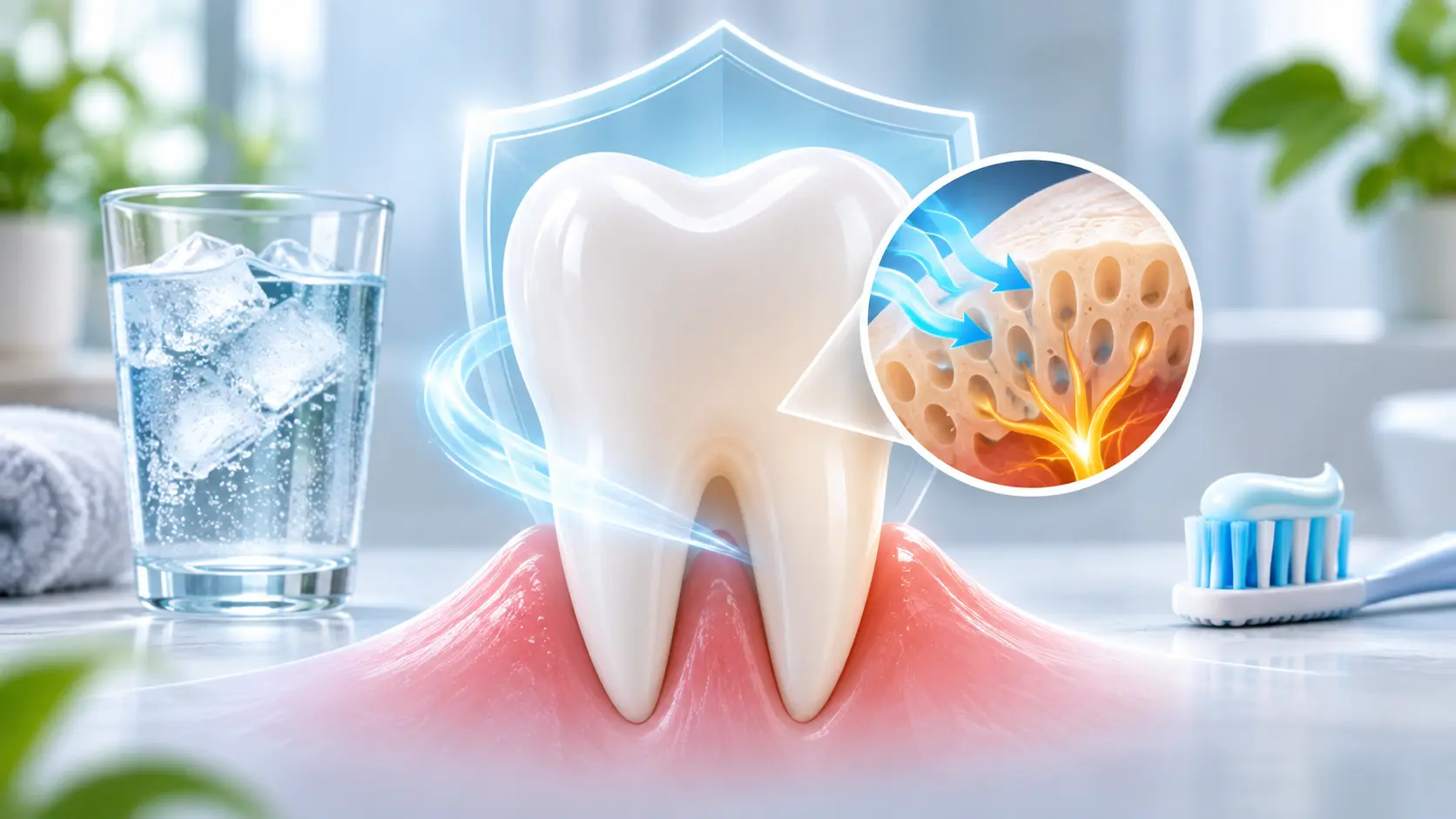
How do sensitive toothpastes work?
Not all desensitizing products work in the same way.
Two broad approaches include:
Reducing nerve excitability
Potassium salts such as potassium nitrate are used in some sensitive-care formulations.
One proposed mechanism is that potassium ions may help reduce the excitability of dental sensory nerves.
Reducing fluid movement in dentinal tubules
Other technologies aim to narrow or occlude dentinal tubules.
These mechanisms are not the same.
What does potassium nitrate do?
Potassium nitrate is a recognised ingredient used in sensitive-care formulations.
Its proposed mechanism is related to reducing the excitability of sensory nerves associated with the tooth.
However:
The presence of potassium nitrate does not prove that every finished product will provide the same magnitude, onset or duration of relief.
Concentration, formulation, exposure route and frequency of use matter.
Does the evidence support sensitive toothpastes?
Overall, yes, but effectiveness is formulation-dependent.
A 2026 systematic review and network meta-analysis compared multiple desensitizing dentifrice technologies and found that some formulations can help manage dentin hypersensitivity.
Performance varied according to technology, stimulus and follow-up period.
A more accurate statement is:
Some desensitizing formulations can help manage dentin hypersensitivity; performance depends on the formulation and how it is used.
Does potassium nitrate always work?
Not as an absolute rule.
Historical evidence on potassium-containing products has not always been uniform.
More recent assessments support some potassium-containing formulations as reasonable options, but certainty varies across products and study conditions.
The Fulgent scientific framework therefore considers the evidence moderate but formulation-dependent.
Can sensitive mouthwash help?
Some research has evaluated mouthwashes containing potassium salts.
A 2023 systematic review and meta-analysis reported benefit for some potassium-salt mouthrinses used at home.
However, toothpaste evidence should not automatically be transferred to mouthwash, or vice versa.
Should a sensitive product work immediately?
Not necessarily.
Some technologies may require regular, continued use before meaningful benefit is seen.
Claims such as “instant relief”, “permanent cure” or “long-lasting relief” require direct finished-product evidence.
Does sensitive toothpaste “repair the nerve”?
No.
That is an overstatement.
Potassium nitrate is generally discussed in terms of modulating nerve excitability, not repairing exposed nerves.
Can brushing too hard contribute to sensitivity?
Excessive brushing pressure may contribute to wear in some people, particularly when factors such as recession or erosion are also present.
But it would be inaccurate to assume that hard brushing is always the cause.
Can acidic foods and drinks play a role?
Repeated acid exposure can contribute to dental erosion and, in some situations, greater dentin exposure.
But a single food or drink should not automatically be labelled the sole cause.
If my tooth only hurts with cold, do I need a dentist?
It depends on severity and pattern.
Professional assessment is more appropriate if the symptom:
- repeats,
- is getting worse,
- is concentrated in one tooth,
- is associated with chewing pain,
- lingers after the trigger is removed,
- occurs spontaneously,
- or comes with other changes.
Is changing behaviour to avoid cold a solution?
Some people:
- chew only on one side,
- avoid cold drinks,
- stop eating ice cream,
- wait for drinks to warm up.
These strategies may reduce exposure to the trigger, but they do not identify the cause.
What should you look for in a sensitive-care product?
1. First understand what the problem may be
Not every toothache is dentin hypersensitivity.
2. Look at the active system
Different sensitive-care products use different technologies.
3. Be cautious with unsubstantiated “instant” promises
Some mechanisms require repeated use.
4. Use the product consistently and as directed
5. Treat absolute claims cautiously
Statements such as “Zero Sensitivity”, “Instant Cure”, “Permanent Relief” or “Repairs Nerves” require strong direct evidence.
Where does Fulgent Sensitive fit?
Current product information indicates that Fulgent Sensitive Toothpaste contains Potassium Nitrate + Sodium Fluoride, while Fulgent Sensitive / Active Care Mouthwash includes potassium nitrate, CPC and fluoride.
This provides a scientifically plausible basis for sensitive-care positioning.
However, in the current evidence package:
- potassium nitrate concentration has not been fully documented,
- the magnitude of relief has not been established for the finished product,
- onset has not been defined,
- duration has not been established.
Fulgent should therefore avoid absolute language such as “instant cure” and use responsible positioning around a sensitive-care formula and accurate ingredient education.
The Fulgent approach: do not normalise sensitivity, but do not create fear
The goal is not to treat every short twinge as a serious disease.
But repeated discomfort should not simply be dismissed as “normal” either.
A balanced approach is:
Notice the symptom → recognise the pattern → choose appropriate care → seek professional assessment if it persists.
Know your need. Choose care that fits it.
Frequently Asked Questions
Why do my teeth hurt when I drink cold water?
Dentin hypersensitivity is one possible explanation, but decay, cracks and other dental problems can cause similar symptoms.
Is tooth sensitivity dangerous?
Dentin hypersensitivity itself does not automatically mean a serious condition, but persistent or unusual pain should be assessed because other conditions can mimic it.
Does sensitive toothpaste really work?
Some desensitizing formulations can help reduce dentin hypersensitivity. Effectiveness depends on the active system, formulation and pattern of use.
How does potassium nitrate help sensitivity?
Its proposed mechanism is to help reduce the excitability of dental sensory nerves.
Should sensitive toothpaste work immediately?
Not necessarily. Some technologies require continued use.
Will sensitive toothpaste help every type of tooth pain?
No. Not every toothache is dentin hypersensitivity.
When should I see a dentist?
Seek professional assessment if pain is severe, persistent, worsening, spontaneous, associated with chewing, concentrated in one tooth, or continues after the trigger is removed.
Scientific Sources
- Gormley AJ, Walsh T, et al. Dentifrice formulations for the treatment of dentin hypersensitivity: a systematic review and network meta-analysis. Periodontology 2000. 2026.
- Li X, et al. Advances in physical and chemical strategies for dentin hypersensitivity therapy. Journal of Advanced Research. 2026.
- Kaur A, et al. Dentin hypersensitivity, an enigma revisited: Mechanisms, diagnosis and therapeutic advances. 2026.
- da Silva ARJ, et al. Clinical efficacy of mouthwashes with potassium salts in the treatment of dentinal hypersensitivity: a systematic review and meta-analysis. Operative Dentistry. 2023.
- FULGENT Scientific Evidence & Claims Library, 2026
Last scientific review: October 2026 Content type: Consumer education Disclaimer: This article is for general educational purposes and does not replace individual diagnosis, assessment or treatment by a dental professional.