
Short answer: No.
Mouthwash can provide additional support in a daily oral-care routine, depending on its formulation and intended use, but it does not replace toothbrushing or mechanical cleaning.
A toothbrush physically contacts tooth surfaces and the gumline, helping disrupt and remove plaque and soft deposits. Mouthwash may add benefits such as fluoride exposure, plaque-control support, gum-care support or freshness, depending on the active ingredients.
The better question is not:
“Brushing or mouthwash?”
but:
“What does brushing do, and what can mouthwash add to that routine?”
Why can mouthwash feel like it should be enough?
Because it is fast, convenient and often produces an immediate fresh feeling.
That can create questions such as:
- “If I use mouthwash, do I still need to brush?”
- “Is mouthwash alone enough?”
- “Why brush if my mouthwash is antibacterial?”
- “Can I just rinse on nights when I am tired?”
The confusion begins when feeling clean is treated as the same thing as mechanically removing plaque.
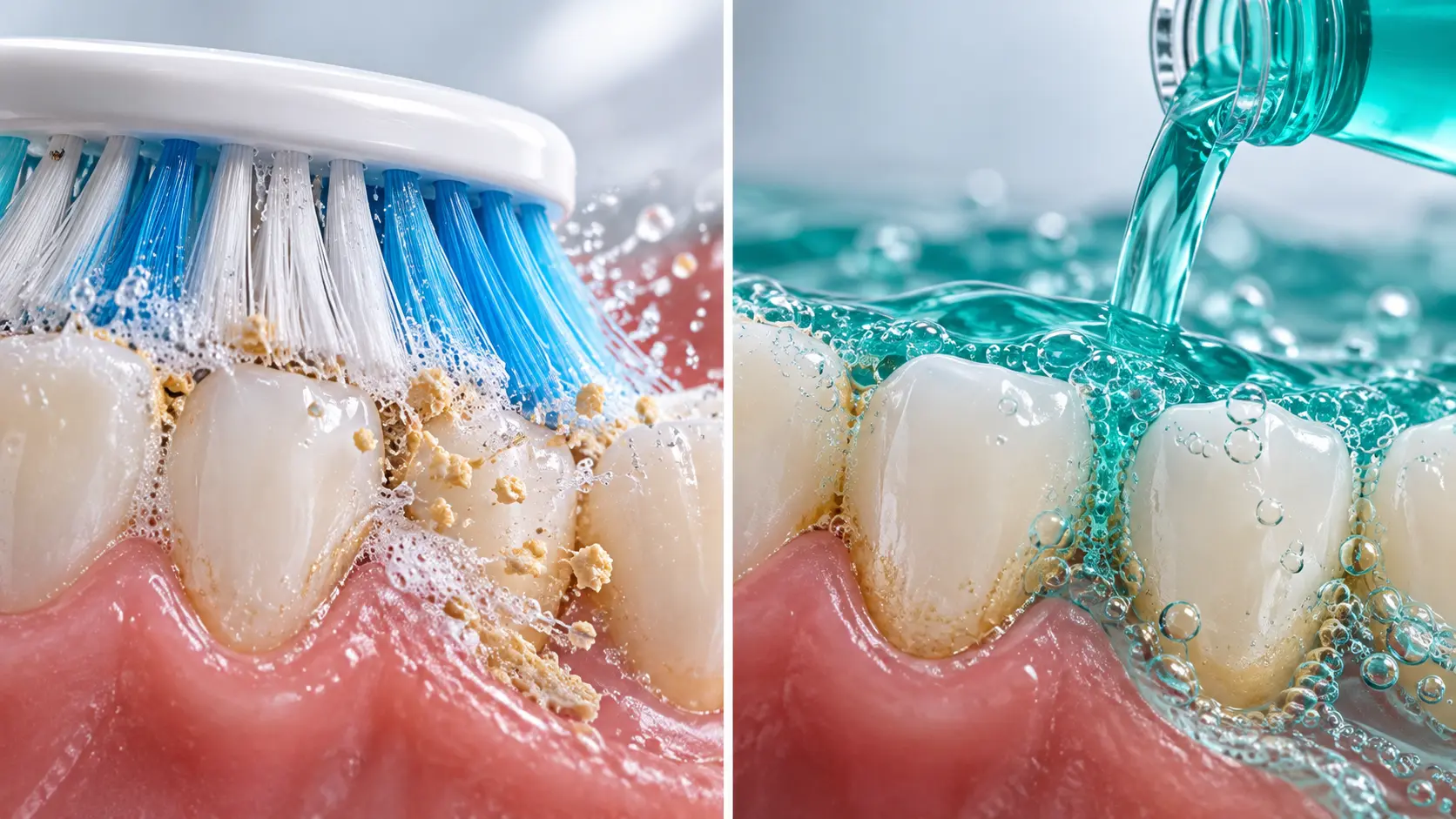
What does brushing actually do?
One of the core functions of toothbrushing is mechanical plaque control.
Dental plaque is an organised microbial biofilm that forms on tooth surfaces. The physical movement of toothbrush bristles helps disrupt and remove this layer.
General guidance recommends brushing twice daily for about two minutes with fluoride toothpaste.
What does toothpaste add?
A toothbrush provides mechanical cleaning. Toothpaste adds active ingredients depending on the formulation.
One of the most important examples is fluoride.
Regular brushing with fluoride toothpaste is a central part of caries prevention.
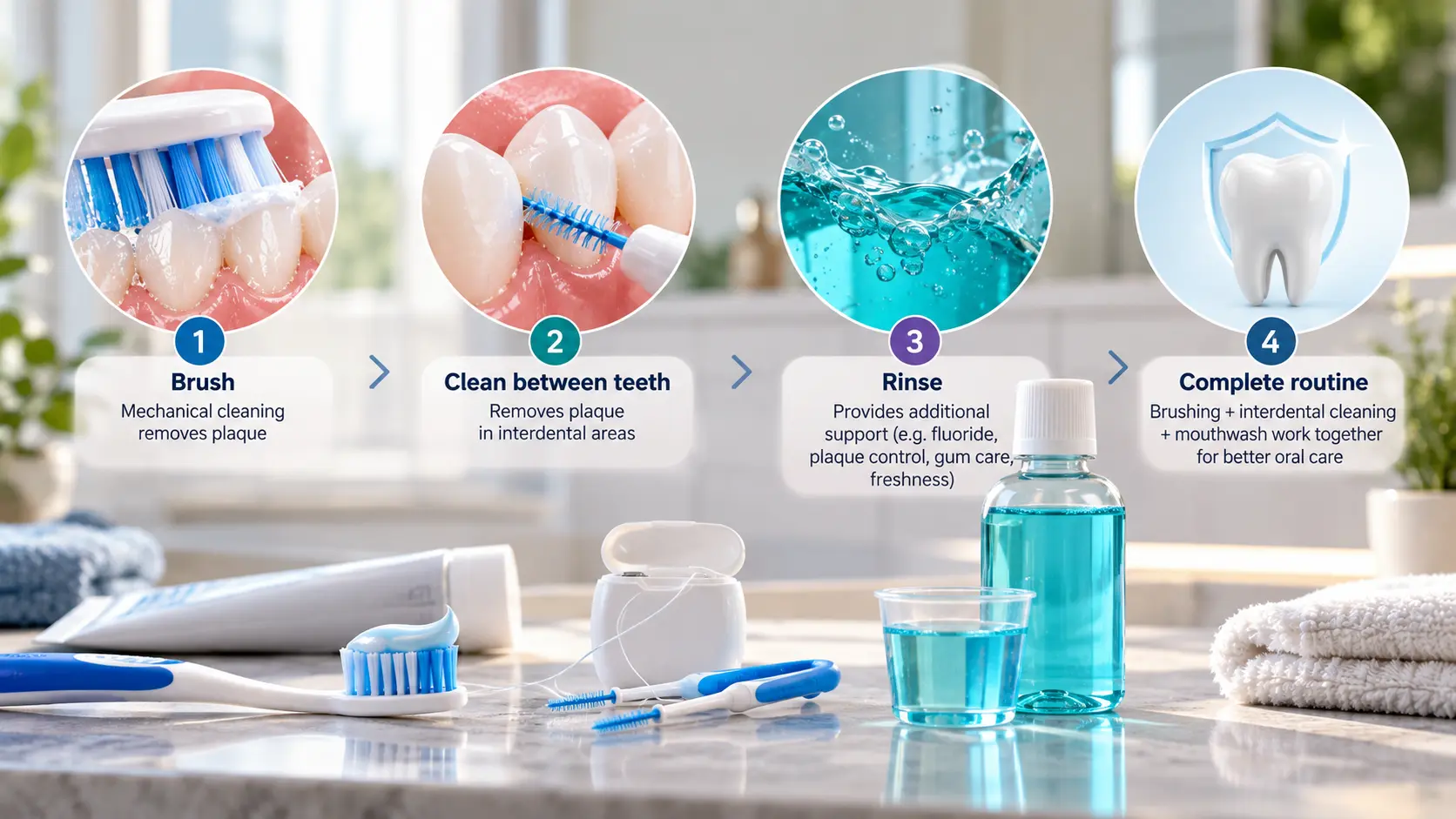
What can mouthwash do?
Not all rinses are the same.
Cosmetic mouthwashes
These mainly provide temporary freshness or a short-term improvement in mouth odour perception.
Therapeutic mouthwashes
Depending on their active ingredients, they may support:
- plaque control,
- gum-care routines,
- fluoride exposure,
- oral-malodour management.
If mouthwash reaches the whole mouth, why can’t it replace brushing?
Because reaching a surface is not the same as mechanically cleaning that surface.
A liquid can contact the teeth, but it does not reproduce the physical disruption created by toothbrush bristles.
What about antibacterial mouthwash?
Chemical and mechanical plaque control are different mechanisms.
Some active ingredients, such as cetylpyridinium chloride (CPC), may provide additional benefits for plaque and gingival outcomes in appropriate formulations and study conditions.
But the key point is that these products are generally studied as an adjunct to toothbrushing.
The scientific model is:
Adjunct to mechanical plaque control
not replacement.
What do recent reviews show?
Recent systematic reviews and umbrella reviews suggest that some daily therapeutic mouthwashes can provide additional improvements in plaque and gingival inflammation measures when used alongside mechanical plaque control.
The effect depends on active ingredient, concentration, formulation, frequency and duration.
Can fluoride mouthwash replace fluoride toothpaste?
For routine care, no.
Fluoride mouthrinses may provide additional fluoride exposure for some people, but the basic recommendation for most individuals remains brushing twice daily with fluoride toothpaste.
In the Fulgent scientific framework, fluoride mouthwash is treated as an additional step, not a replacement for twice-daily brushing.
If I am too tired to brush, is mouthwash enough for one night?
No. Mouthwash does not produce the same result as brushing.
A better principle is:
Simplify the routine if necessary, but do not confuse the role of each step.
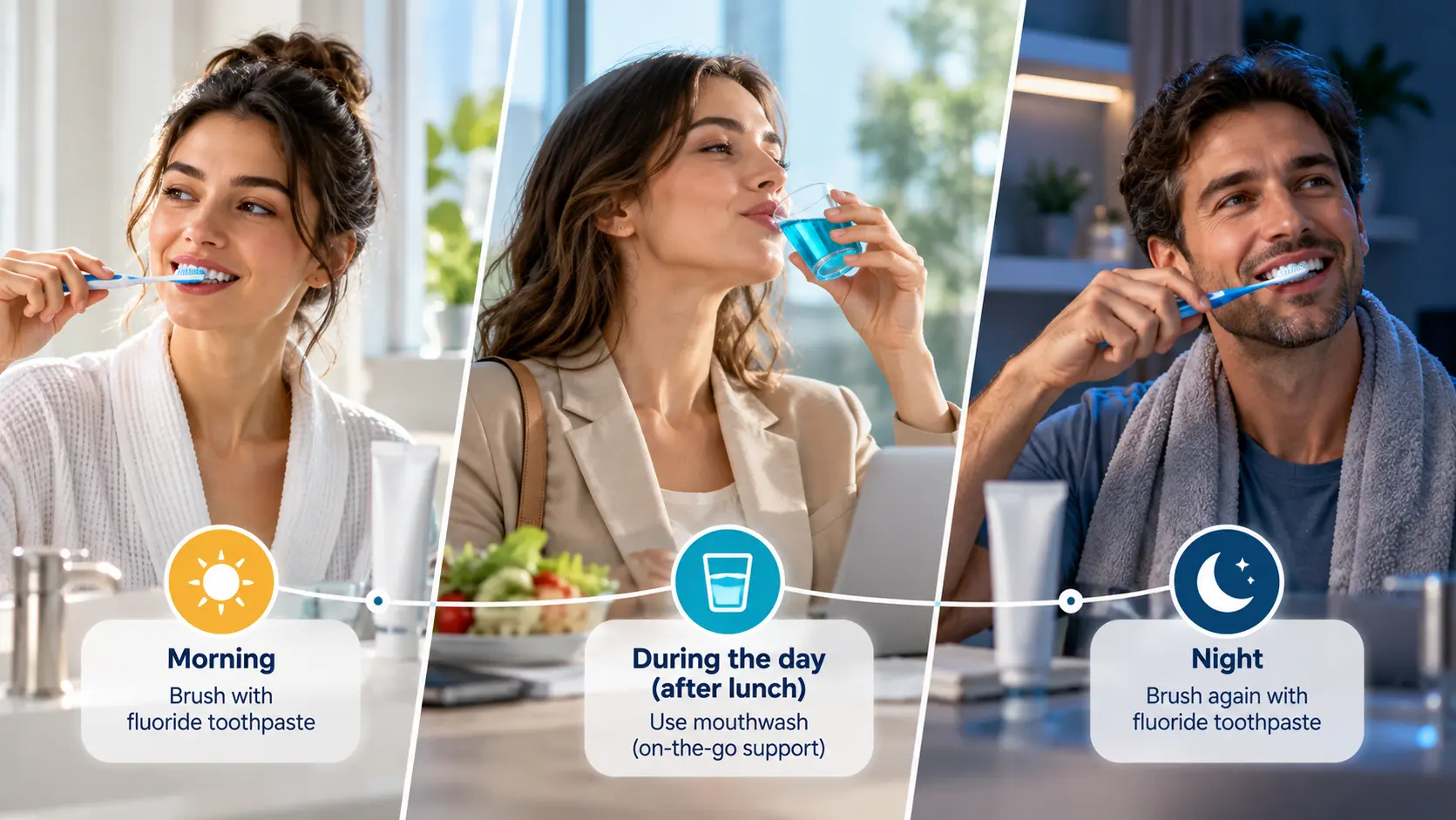
If I use mouthwash after lunch, do I still need to brush?
Mouthwash and brushing do not always need to happen at the same time.
For example:
- brush in the morning,
- use an on-the-go product after lunch,
- brush again at night.
In this case, mouthwash supports continuity during the day rather than replacing the main brushing routine.
Should mouthwash be used before or after brushing?
There is no single universal answer.
The sequence may depend on the formulation and the manufacturer's directions. Follow the product instructions.
Can mouthwash replace floss or interdental brushes?
No.
Interdental plaque removal is a separate mechanical task.

Why does my mouth feel so clean after rinsing?
Because freshness perception and mechanical plaque removal are different things.
Menthol and flavour systems can create cooling, freshness and a clean taste, but that does not prove that plaque has been fully removed.
Does everyone need mouthwash?
No.
The need may depend on caries risk, gum condition, additional fluoride needs, a specific oral-care goal, professional recommendation or preference for freshness.
Is more mouthwash better?
No.
Using more liquid, rinsing longer or using the product more often does not automatically create more benefit.
Can children use mouthwash instead of brushing?
No.
For children, the foundation remains age-appropriate brushing with fluoride toothpaste and appropriate supervision.
Current Fulgent Dino Kids mouthwash positioning is for children aged 6+, with adult supervision and instructions to rinse and spit without swallowing.
What does a sensible daily routine look like?
Core step
Brush twice daily with fluoride toothpaste
Areas the toothbrush may not clean fully
Use appropriate interdental cleaning
Optional additional step
Use a mouthwash that fits a specific need
A useful model is:
Mechanical Cleaning → Active Care → Optional Adjunct
The Fulgent approach: an adjunct, not a shortcut
At Fulgent, mouthwash should not be positioned as a faster version of brushing.
Its appropriate role is:
A complementary care step for a defined need.
The Fulgent principle is:
Keep the core routine. Add the right care when you need it.
Know your need. Choose care that fits it.
Frequently Asked Questions
Can mouthwash replace brushing?
No. Mouthwash may complement the routine, but it does not replace mechanical toothbrushing.
If my mouthwash is antibacterial, do I still need to brush?
Yes. Antimicrobial activity and mechanical plaque removal are different mechanisms.
Is mouthwash alone enough for one night?
No. Mouthwash is not equivalent to brushing.
Can fluoride mouthwash replace fluoride toothpaste?
No. Fluoride mouthwash may provide additional fluoride, but it does not replace routine brushing with fluoride toothpaste.
Should mouthwash be used before or after brushing?
It depends on the product. Follow the manufacturer's directions.
Can mouthwash replace flossing?
No. Interdental cleaning remains a mechanical task.
Scientific Sources
- American Dental Association — Mouthrinse (Mouthwash)
https://www.ada.org/resources/ada-library/oral-health-topics/mouthrinse-mouthwash
- American Dental Association — Home Oral Care
https://www.ada.org/resources/ada-library/oral-health-topics/home-oral-care/
- American Dental Association — Floss / Interdental Cleaners
https://www.ada.org/resources/ada-library/oral-health-topics/floss/
- Effect of Adjunctive Use of Commercial Daily Mouthwashes on Periodontal Health: An Umbrella Review
- The Effect of Cetylpyridinium Chloride Mouthrinse as Adjunct to Toothbrushing Compared to Placebo — Systematic Review and Meta-analysis
- FULGENT Scientific Evidence & Claims Library, 2026
Last scientific review: October 2026 Content type: Consumer education Disclaimer: This article is for general educational purposes and does not replace individual evaluation or advice from a dental professional.